
Beyond All Reasonable Doubt, Melissa Lozada-Oliva is One of Our Greatest Literary Treasures
Exploring the themes and nightmares of "Beyond All Reasonable Doubt, Jesus is Alive!"

2021 was a banner year when it came to a lot of the books I read. I found myself getting back into this groove of reading, with plenty of exciting titles expanding the literary landscape. One that truly stuck out, however, was a little novel-in-verse featuring a protagonist fooling around with magic and somehow resurrecting one of music’s most towering pop stars—Selena Quintanilla.
Melissa Lozada-Oliva’s Dreaming of You stands as one of the most exciting debuts to release in the last decade. A surreal and poetic exploration of identity, fame, and the modern ouroboros that is the music industry. Our young protagonist struggles with loneliness and heartbreak, thus deciding to try contacting/reviving the Tejano juggernaut we all fell head-over-heels for in the 90’s. The book employs verse as a means of simultaneously lulling the audience in with beauty and utterly confounding them. A Greek chorus of catty It-girls hold court over events, but if you can imagine these storytellers as a gossipy liberal “Brunch Crowd.” Selena herself is engulfed by modern celebrity worship, setting her on a collision course with the inevitable crash often following fame.
Lozada-Oliva is an accomplished poet and writer in her own right, so to have Dreaming of You as an entry point into her work was nothing short of amazing. The horror genre was only just re-claiming its history as a revolutionary subset of literature, with authors receiving mainstream attention and acclaim for their approach toward trauma, racism, grief, and so much more. While Dreaming of You is not explicitly horror, the elements are there, and it was with the author’s sophomore novel, Candelaria, that these elements solidified into something truly powerful and deserving as just as much attention as other, more mainstream authors.
Part apocalyptic survival, part evisceration of wellness culture, but wholly a tale of cosmic body horror and familial/generational trauma and healing, Candelaria features the author’s gorgeous evolution in ways it sometimes takes writers years to achieve. Introducing us to the fractured family of our titular matriarch, Candelaria, the story follows her perilous trek through a world quickly falling apart around her. People are rising from the dead, plus the streets themselves are seeming to crack apart as earthquakes reverberate throughout the city. Candelaria’s main concern? Getting to an old style buffet that—to her daughter’s utter bafflement—becomes a life or death mission for her elderly mother.
Fractures are widening amongst Candelaria’s granddaughters as well. Bianca, the scientist, is facing the collapse of her archaeological career, abandoning her life’s work due to her own supervisor’s indiscretions and disappearance. Re-appearing, however, is sister Paolo. Having disappeared herself over a decade ago, her return to Boston finds a completely new woman named Zoe, having been brainwashed by a wellness cult. Lastly, there’s Candy, the youngest, recovering from addiction and suddenly pregnant from a man she’s not sure even actually exists on this plane.
What does that mean for the baby then? And why is Candy suddenly craving human flesh?
Literary, hilarious, horrifying, but most importantly, tender, Candelaria is unlike anything you’ve ever read. For every point of cultural critique, much like in Dreaming of You, Lozada-Oliva offers a staggering amount of heart. What makes this novel so special is how much more heart displays throughout, both in the family dynamics and from within the supporting characters.
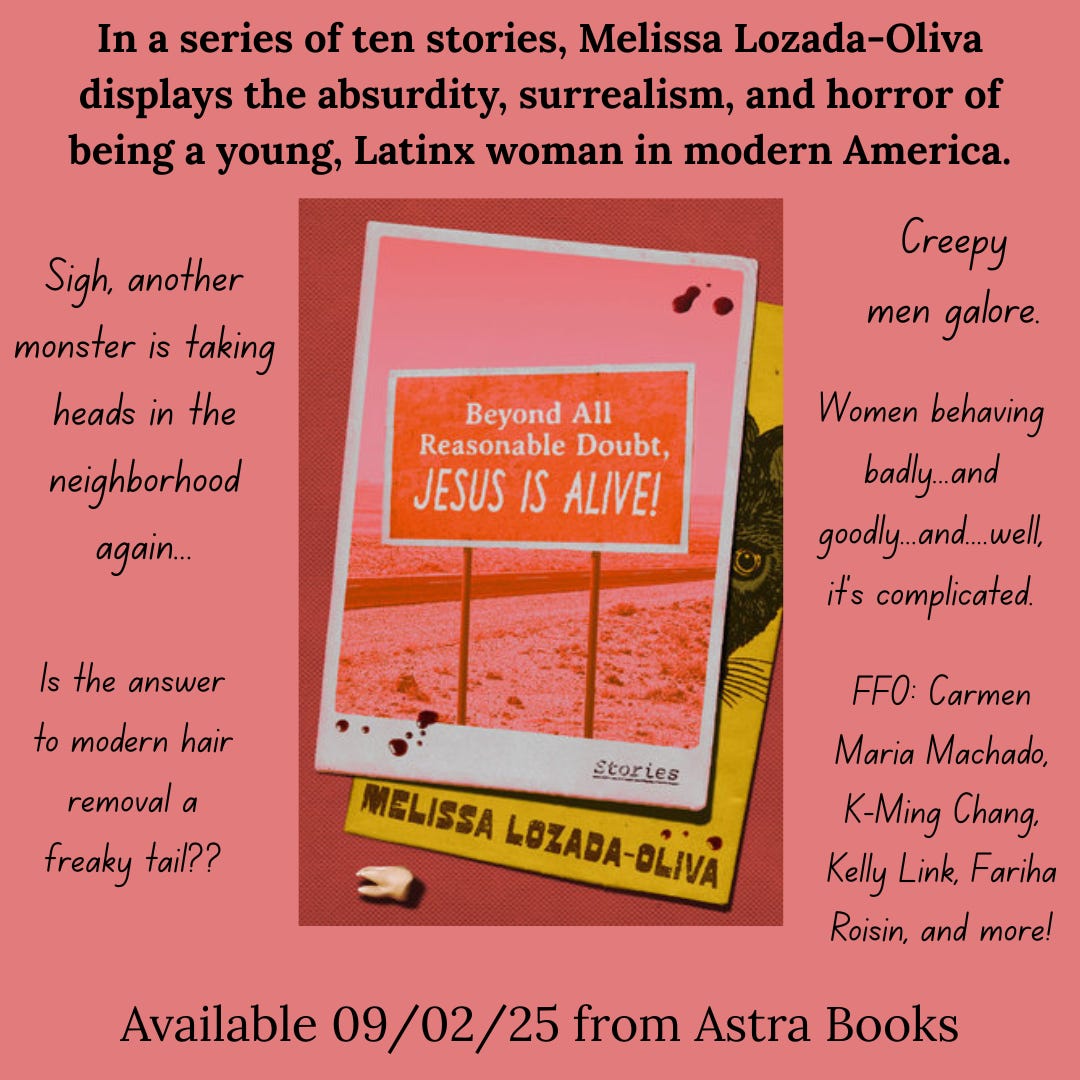
2025 will see a new release from this startling talent, though now in the form of short stories. Beyond All Reasonable Doubt, Jesus is Alive! features a collection of absurdities, both mundane and pants-pissingly horrifying, exploring the myriad ways culture, identity, racism, and even our old friend class, affect our day-to-day lives and misadventures. The women in these stories navigate predatory teachers, strange creatures, odd futures, fame, kidnapping, and much more. Ranging from humorous to unsettling, like many of her contemporaries, Melissa Lozada-Oliva carves out her own unique space with her singular voice and empathy.
For those who enjoyed the cosmic/body horror themes of Candelaria, you’ll be excited to find some of that in this collection. Most prevalent in the stories “Heads” and “Tails,” both explore the intersections of identity, class, generational wealth and trauma, as well as commentary surrounding the future of prisons.
“Heads” takes place in a future simultaneously “dystopic” and a seeming natural progression of the uncertainty we sit within currently. Our narrator, Mari, is turning 18 and much of her future remains uncertain due to the traumas of her past, specifically surrounding her father, who is kept in the Halls, a proto-prison-reformation center. It’s inferred he murdered Mari’s mother, but we’re also told there’s someone—or something—killing and beheading animals and people in the town.
This is a speculative story that functions predominantly on the characters, as well as their larger connections to each other. The setting of a distant, yet familiar landscape places us within enough bounds of uncanny that you feel the dread and unease throughout, especially whenever the “monster” shows up, seemingly attracted to Mari, specifically. This causes her to believe it’s her father, somehow escaping from the Hills and trying to reach her. It’s a heart-wrenching coming of age, where Mari is attempting to imagine her life forward, yet there are real traumas and griefs she’s contending with.
The Halls is a fascinating setting within “Heads,” as well, offering an answer to prisons that’s not meant to be an answer. As Mari introduces us to the center itself, we learn that:
A lot of care goes into these facilities, and some cynics think that neighbors will cause harm in order to get the Halls treatment, but who are they kidding? Nobody really wants to be here. - pg. 44
So the Halls essentially combine rehabilitation centers and prisons together. A golden banner within the entrance proclaims, “WE ARE NOT WHAT WE HAVE DONE; WE ARE WHAT WE CAN BECOME,” calling to mind the co-opting of this kind of transformative terminology. Or, perhaps, the Halls began with a much more valiant mission in mind, only to fall prey to bureaucracy? Hard to say.
Mari even reads from a pamphlet before she tries to meet with her father, that goes a bit deeper into the mission statement of the Halls:
For decades the Halls have committed themselves to rehabilitation of those who have Taken Life or Severely Traumatized the Lives of Others. Our patients undergo daily therapy sessions and have their choice of one to six “extracurricular” art activities. We have a gym facility for patients— - pg. 46
It becomes evident that humanity essentially dissolved policing into rehabilitation services and couched it in flowery/psychological language. It was an aspect of the story I greatly appreciated, all the more bolstered by the unfortunate scene of this world’s authorities showing up to assist Mari, only to find they are way out of their league and are summarily torn apart.
In “Tails,” a young woman’s step-aunt passes down a family inheritance to her, which tuns out to be a strange appendage, essentially removing all hair from her body and offering a chance at beauty that doesn’t come with the pain of waxing. What makes this story especially prescient is it tackles a conversation we’ve been attempting to have for years.
Body hair, and its status as a hinderance to beauty, has always had its connections to white supremacy, as European beauty standards have been forced upon every colonized country. While there has been pushback against this concept in the last couple decades, with women being more willing to grow out their leg and armpit hair as a means of giving the patriarchy a big middle finger. However, there’s an added race component to this as well.
Part of why body hair became so policed is due to how many cultures saw hair as a sacred element to ritual, practices, and so much more. One of the first things done to the Indigenous boys sent off to residential schools was cut their hair—yet another dehumanization tactic to rip them violently away from their way of life. In Latinx communities, body hair is often seen as something to do battle with constantly; you know, so women don’t walk around with mustaches all the time, obviously!
Even for trans folks, if you’re someone looking to transition into a more feminine presentation, removing body hair is often a large part of “passing” in the wider world. It’s expected for women to not have body hair, so it’s only natural to remove that hurdle as a way of appearing more visibly trans, right?? Well, this is unfortunately what many of us tell ourselves, especially at the beginning of our gender journeys. I have had to reckon with this imperialist ideology surrounding beauty, especially as someone who currently cannot afford gender affirming care such as Facial Feminization Surgery or electrolysis, but ESPECIALLY because of its roots in white supremacy.
So, having hair be a fairly central theme to this story in particular is a massive move from Lozada-Oliva. It’s clear our narrator has struggled with her body hair for so long, so despite being utterly terrified of the tail, it’s almost a godsend. Well…until it’s not. But I’ll let readers figure that one out.
All the cosmic/body horror aside, “Heads” and “Tails” function as fascinating analogs to one another, as well as a cheeky reference to the duality of coins, as well as the binary choices we’re often forced to make by society at large. As this collection’s synopsis posits, these stories present “a tapestry of women ailing for something to believe in—even if it hurts them.” Mari, and the narrator of “Tails” are such women, presented with worlds and supernatural tails that seem as though they know the direction they’re going in, or that these items or concepts may help them find said direction, yet only leaving destruction in their wake.
Those are merely my two favorite stories from the collection. The title story, “Beyond All Reasonable Doubt, Jesus is Alive!” tells of a student finding attention from a predatory professor. The narration is this students confession to her friend over allowing his advances and special attention. When the two witness a billboard proclaiming Jesus’s miraculous living, it forces the character and audience to reckon with these choices, as well as their murky morality.
“The Heiress” is a particularly hilarious story, featuring a friend/helper (??) of a well-known heiress. When the friend leaves one day, she is kidnapped due to wearing one of the heiress’ coats. She’s placed under the watch of one of the younger kidnappers, holding her at gunpoint. However, this kid doesn’t seem the type to simply gun a random person down, so they wind up on what feels like a romantic comedy date, despite the, ya’know, GUN.
Its utter absurdity paves the way for even further explorations of class, placing readers in the shoes of the narrator, but the kidnapper as well. The framework of “something to believe in” shifts onto the kidnapper, whose involvement in this scheme is likely due to financial desperation—the same reason for much of the crime we’re conditioned to demonize without nuance.
“Pool House,” too, explores class, as the narrator details the three times she’s seen a particular family member whose struggles with money and drugs have positioned her as a black sheep in the family. Lozada-Oliva perfectly encapsulates the often toxic ways in which family members discuss those who perhaps struggle more than they do, taking on the ever-present bootstraps mentality Americans so lovingly tout.
Though the author leaves one of her most damning stories for last. “Community Hole” is a novella focused on a “cancelled” musician who begins to live at a haunted punk house. This is perhaps the most thought-provoking of the entries, as the subject of cancelations and the movement’s immense loss of identity, having stripped all of the political nuance from the concept to merely perpetuate further carceral indoctrination and punishment. Lozada-Oliva additionally provides us with the context of what happened to get the central character canceled, her relationship with one of the members being a bit too close for our narrator to see the immense harm being done by her love.
The supernatural elements act as a lifeline for the character, allowing her to attempt at finding absolution; though the larger theme is more evidently celebrity worship, being that we allow ourselves to be enraptured by a class that mostly views us as insects under their feet. “Community Hole” is not concerned with whether cancel culture is necessary or overblown, but rather how the ultimate infallibility of humanity will always lead us to cause harm. It’s how we move on from that harm that is ultimately important.
All ten stories in Beyond All Reasonable Doubt skirt the line between hilarious and horrifying, prescient and hopeful, yet with an undying curiosity ever-present throughout each shape-shifting tale. Regardless of the humanity of the character, Melissa Lozada-Oliva makes sure readers find it in every single character we come by. It’s a device intimate to speculative short fiction, but feels so fresh and dynamic within her more than capable hands. No matter your particular flavor of fiction, there is something for all readers to love, not just in her fiction, but her poetry as well.
In a landscape where short fiction is more popular than it ever has been, this collection stands amongst the giants, yet asserts its own identity thanks to the breathtaking talent of its author. If you know what’s good for you (and your TBR), you should absolutely keep your eyes peeled for this emerging, and necessary voice in fiction.
I’d like to thank Astra House for the early ARC of this stunning collection, as well as my immense thanks and love to Melissa, whose kindness and enthusiasm helped change my life as a bookseller forever! Beyond All Reasonable Doubt, Jesus is Alive will be available 09/02/25, AND, if any of this review caught your attention…Melissa will be joining Big Blue Marble on tour this fall. We’ll be celebrating the release with Melissa and songwriter/author Sady Dupois of Philadelphia legends Speedy Ortiz.
The event is 09/09/25, so mark your calendars and come party with us!!